


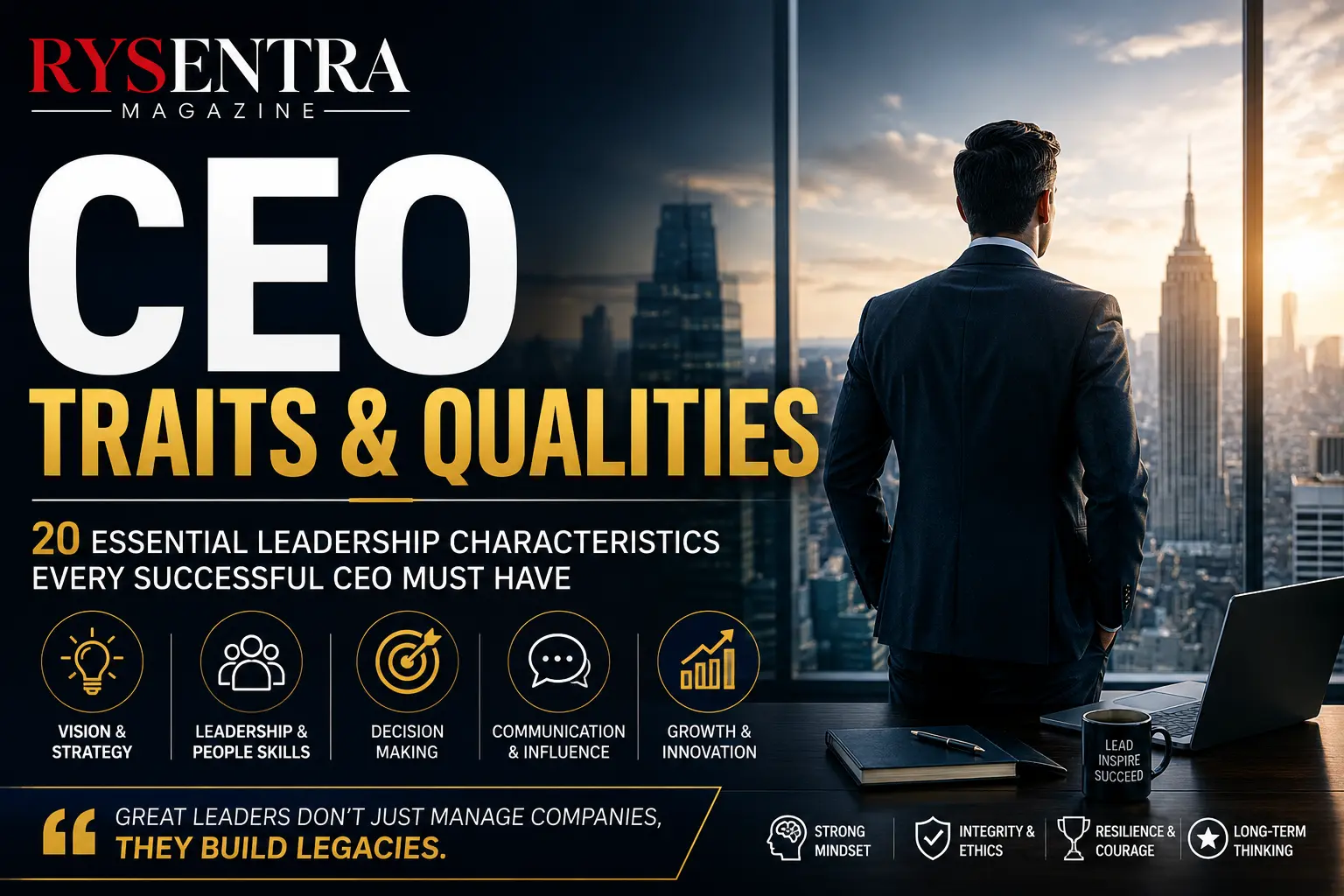
CEO Traits and Qualities: The Complete Guide to Becoming an Exceptional Business Leader
Behind every successful company is a CEO who possesses a unique combination of leadership, strategic thinking, resilience, and vision. Whether you’re leading a startup, managing a growing enterprise, or aspiring to become a chief executive officer, understanding the essential CEO traits and qualities is critical for long-term business success.
Today’s CEOs face rapidly changing markets, technological disruption, global competition, cybersecurity threats, and evolving customer expectations. As a result, effective CEOs must combine emotional intelligence with data-driven decision-making while inspiring teams to achieve ambitious goals.
In this comprehensive guide, we’ll explore the 20 most important CEO traits and qualities, explain why each matters, and provide practical ways to develop them.
Why CEO Traits Matter
A CEO does much more than oversee daily operations. They define company vision, build organizational culture, make high-impact decisions, attract top talent, manage risk, and represent the business to customers, investors, and stakeholders.

Research consistently shows that leadership quality directly influences:
- Business growth
- Employee engagement
- Innovation
- Customer satisfaction
- Financial performance
- Organizational resilience
Developing strong leadership traits isn’t optional—it’s one of the greatest competitive advantages a CEO can have.
1. Visionary Thinking
One of the defining CEO traits and qualities is the ability to see opportunities long before others recognize them.
Visionary CEOs don’t simply react to market changes—they anticipate them.
They ask:
- Where will the industry be in five years?
- What problems will customers face?
- How can we innovate before competitors?
How to Develop Vision
- Study industry trends
- Read business research regularly
- Network with innovators
- Analyze emerging technologies
- Think beyond quarterly results
2. Strategic Decision-Making
Great CEOs make difficult decisions confidently while balancing risk and reward.
Every major business decision affects employees, customers, shareholders, and future growth.
Successful CEOs evaluate:
- Financial impact
- Long-term strategy
- Market conditions
- Customer expectations
- Organizational capabilities
Strategic thinking separates exceptional leaders from average managers.
3. Excellent Communication Skills
Communication is among the most valuable qualities of a successful CEO.
CEOs communicate with:
- Employees
- Customers
- Investors
- Board members
- Media
- Business partners
Effective communication builds trust, eliminates confusion, and aligns everyone toward common goals.
Strong CEO Communication Includes
- Active listening
- Clear messaging
- Public speaking
- Transparent leadership
- Constructive feedback
4. Emotional Intelligence
Modern leadership depends heavily on emotional intelligence.
Emotionally intelligent CEOs understand both their own emotions and those of others.
This helps them:
- Resolve conflicts
- Build stronger teams
- Improve employee morale
- Increase retention
- Strengthen workplace culture
Emotional intelligence is often more valuable than technical expertise.
5. Integrity and Ethics
Trust is the foundation of leadership.
Employees willingly follow leaders who demonstrate honesty, fairness, and accountability.
Ethical CEOs:
- Keep promises
- Admit mistakes
- Act transparently
- Build credibility
- Protect company reputation
Integrity creates long-term business sustainability.
6. Adaptability
Markets evolve constantly.
Economic uncertainty, AI, automation, remote work, and digital transformation require CEOs to adapt quickly.
Adaptable CEOs embrace:
- Innovation
- Continuous learning
- Technology adoption
- Market changes
- Organizational transformation
Flexibility is now a leadership necessity.
7. Decisiveness
Indecision costs businesses valuable opportunities.
Top CEOs gather relevant information, evaluate options, and make timely decisions—even under pressure.
Successful leaders understand that delayed decisions can be riskier than imperfect ones.
8. Accountability
Exceptional CEOs never blame others for organizational failures.
Instead, they:
- Accept responsibility
- Learn from mistakes
- Improve processes
- Encourage ownership
- Lead by example
Accountability builds a culture of responsibility throughout the organization.
9. Innovation Mindset
Innovation drives sustainable growth.
Successful CEOs encourage experimentation, creativity, and continuous improvement.
They ask:
- Can we improve this process?
- Can technology simplify operations?
- Are we solving the right customer problem?
Innovation isn’t limited to products—it includes business models, marketing, customer service, and operations.
10. Customer-Centric Thinking
Every successful CEO understands that customers ultimately determine business success.
Customer-focused CEOs prioritize:
- Customer satisfaction
- User experience
- Product quality
- Service excellence
- Long-term relationships
Listening to customers often reveals the next growth opportunity.
11. Financial Intelligence
CEOs don’t need to be accountants, but they must understand financial performance.
Strong financial knowledge helps leaders evaluate:
- Revenue growth
- Profit margins
- Cash flow
- Operational costs
- Investment opportunities
Financial literacy enables smarter strategic decisions.
12. Resilience
Business challenges are inevitable.
Market downturns, product failures, funding issues, and unexpected crises test every CEO.
Resilient leaders remain calm, optimistic, and solution-focused even during uncertainty.
Their confidence inspires employees to stay committed through difficult times.
13. Talent Development
The best CEOs understand they cannot succeed alone.
They recruit exceptional people and invest in developing future leaders.
High-performing organizations prioritize:
- Employee training
- Leadership development
- Mentorship
- Career growth
- Performance recognition
Strong teams create sustainable success.
14. Time Management
CEOs manage countless responsibilities every day.
Effective executives prioritize activities that generate the greatest strategic value instead of simply staying busy.
Common priorities include:
- Strategic planning
- Customer meetings
- Talent development
- Innovation initiatives
- Investor relations
Delegation is a critical component of effective time management.
15. Confidence with Humility
Confidence helps CEOs make bold decisions.
Humility allows them to:
- Listen to experts
- Accept feedback
- Learn continuously
- Admit mistakes
- Improve leadership
The strongest CEOs combine confidence with openness to learning.
16. Problem-Solving Ability
Every organization faces challenges.
Exceptional CEOs approach problems systematically:
- Identify root causes
- Gather relevant data
- Evaluate alternatives
- Implement solutions
- Measure outcomes
Strong problem-solving improves organizational agility.
17. Negotiation Skills
Negotiation influences nearly every aspect of executive leadership.
CEOs negotiate with:
- Investors
- Vendors
- Customers
- Partners
- Executives
- Government agencies
Successful negotiations create value for all parties while protecting organizational interests.
18. Continuous Learning
The world’s best CEOs remain lifelong learners.
They regularly:
- Read business books
- Attend leadership conferences
- Learn emerging technologies
- Seek executive coaching
- Study successful companies
Continuous learning keeps leaders competitive.
19. Courage
Leadership often requires making unpopular decisions.
Whether restructuring an organization, entering new markets, or investing heavily in innovation, courage distinguishes transformational CEOs.
Bold leadership frequently creates extraordinary business results.
20. Long-Term Thinking
Outstanding CEOs balance today’s performance with tomorrow’s opportunities.
They invest in:
- Research and development
- Employee development
- Brand reputation
- Customer loyalty
- Sustainable growth
Long-term thinking creates businesses that endure for decades.
How to Develop CEO Traits and Qualities
Leadership isn’t purely innate—many executive skills can be developed with deliberate practice.
Practical steps include:
- Read leadership books every month.
- Find experienced mentors.
- Request regular feedback.
- Improve communication skills.
- Learn financial management.
- Practice strategic thinking.
- Develop emotional intelligence.
- Study successful CEOs.
- Invest in executive coaching.
- Embrace continuous improvement.
Small, consistent improvements compound into exceptional leadership over time.
Common Mistakes New CEOs Make
Even talented leaders can stumble by falling into predictable traps:
- Micromanaging employees
- Avoiding difficult conversations
- Delaying important decisions
- Ignoring company culture
- Resisting change
- Overlooking customer feedback
- Focusing only on short-term profits
- Failing to delegate
- Neglecting leadership development
- Making decisions without reliable data
Recognizing these mistakes early helps CEOs build stronger organizations.
Final Thoughts
The most successful CEOs are not defined by a single characteristic but by a balanced combination of vision, integrity, resilience, communication, adaptability, and strategic thinking.
Developing these CEO traits and qualities takes time, experience, and intentional effort. Whether you’re leading a startup, managing a multinational corporation, or preparing for your first executive role, investing in these leadership qualities will strengthen your ability to inspire people, navigate uncertainty, and build a thriving organization.
Leadership is a journey of continuous growth. The CEOs who embrace learning, remain customer-focused, empower their teams, and make principled decisions are the ones most likely to achieve lasting success.
Frequently Asked Questions (FAQs)
What are the most important CEO traits and qualities?
The most essential CEO traits include visionary thinking, strategic decision-making, communication skills, emotional intelligence, integrity, adaptability, resilience, accountability, financial literacy, and customer-centric leadership.
Can CEO qualities be learned?
Yes. While some personality traits come naturally, most leadership skills—including communication, strategic thinking, negotiation, and decision-making—can be developed through experience, education, coaching, and continuous learning.
Why is emotional intelligence important for CEOs?
Emotional intelligence enables CEOs to build trust, resolve conflicts, motivate teams, improve collaboration, and create a positive organizational culture.
What leadership style do successful CEOs use?
Successful CEOs often combine transformational, servant, and strategic leadership styles, adapting their approach to the organization’s needs and business environment.
Which CEO trait contributes most to business success?
Vision combined with effective execution is often considered the most valuable combination. A compelling vision inspires people, while disciplined execution turns ideas into measurable results.