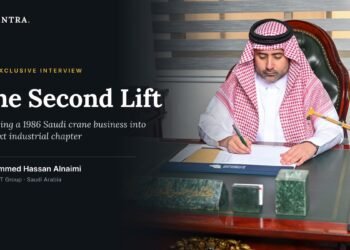

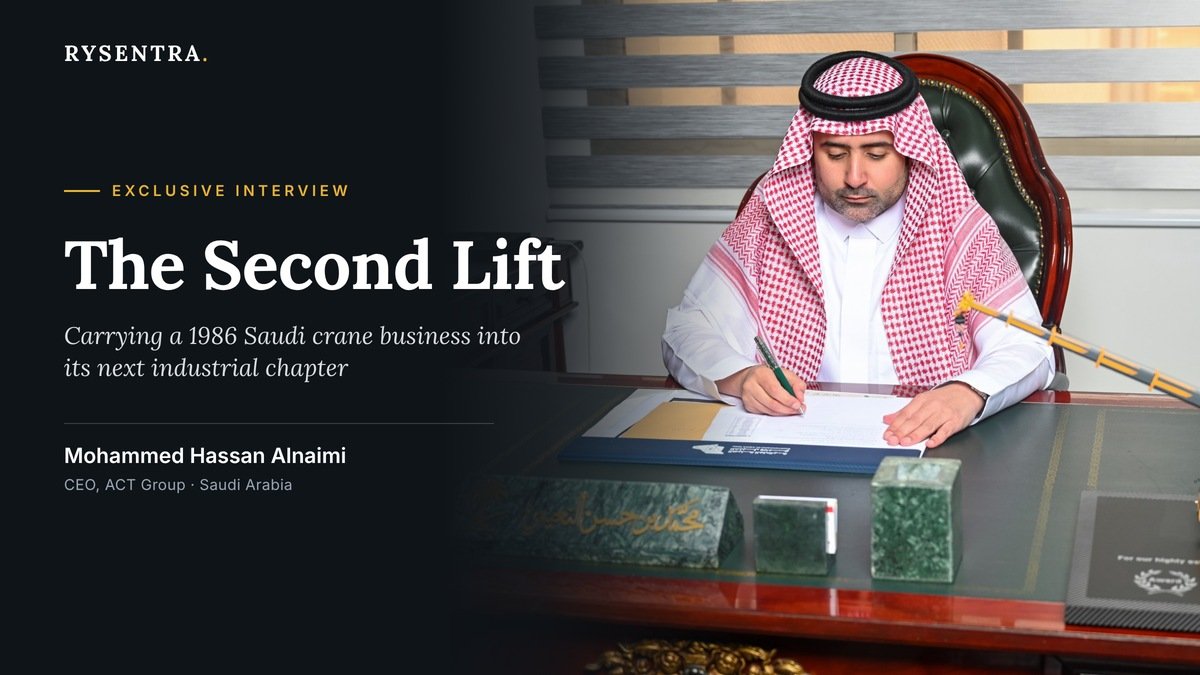
EXCLUSIVE INTERVIEW | By Rysentra Editorial Team
The ACT Group CEO explains why heavy lifting is a trust business, why Saudi talent is the real fleet expansion, and why he is in no hurry to buy the future before the infrastructure is ready.
By Rysentra Editorial Team
Most founders are judged on what they build. Second-generation leaders are judged on something harder: whether they can take what was built and make it stronger without breaking what made it work.
That is the job Mohammed Hassan Alnaimi took on as Chief Executive Officer of ACT Group. Arabian Consolidated Trading was founded in Saudi Arabia in 1986 by Hassan Mohammed Rashid Al-Naimi. From its headquarters in Jubail, with offices in Riyadh, Dammam, Yanbu and Dubai, it has grown into one of the Kingdom’s established names in mobile cranes and heavy lifting, with a fleet of around 250 cranes and roughly 1,000 people.
For Alnaimi, the inheritance is not the fleet. It is the reputation behind it.
“A crane is a machine anyone can buy,” he says. “What a client is really buying is the confidence that the lift will happen safely, on time, the first time. That confidence took decades to earn. My responsibility is to make sure it is still true in the next decade.”
A Trust Business Disguised as an Equipment Business
Much of ACT’s work happens where mistakes are least forgiven: inside oil refineries and petrochemical plants, during maintenance shutdowns and turnarounds. Through its sister company, Arabian Consolidated Industrial Cleaning (ACIC), the group also supports full shutdown and turnaround services for petrochemical facilities.
In that environment, safety is not a value statement. It is the product.
“In a refinery shutdown, every hour of downtime has a cost, and every lift has a consequence,” Alnaimi says. “So we make our decisions backwards from the worst day, not the best one. Which crane, which operator, which service support — all of it is chosen for the day something goes wrong.”
That logic shapes how the company buys equipment. ACT bought its first Liebherr crane in 1987 and has kept the relationship for nearly four decades. It typically buys cranes fully equipped rather than adding options later, and it brought the first Liebherr LTM 1650-8.1 all-terrain crane into Saudi Arabia. In December 2023 it placed an order for 18 new Liebherr cranes in the 100 to 150-tonne range.
“Long partnerships are underrated,” he says. “When a manufacturer has known your fleet for thirty-plus years, the conversation is not about price. It is about uptime, parts and people who answer the phone at two in the morning.”
The Real Fleet Expansion Is People
Ask Alnaimi what growth looks like and the answer rarely starts with machines.
ACT has made Saudi talent a measurable priority. In 2023 the company reported a Saudisation rate of 25% within ACT Cranes, with close to 400 Saudi employees across its divisions. Alnaimi has spoken publicly about training Saudi operators and technicians to international standards.
“You can import a crane in months,” he says. “You cannot import an experienced operator who knows the site, the client and the standard. That person has to be developed. If we want Saudi industry to run on Saudi capability, companies like ours have to do the training, not just talk about it.”
He sees it as the difference between growing a company and growing an industry. “A bigger fleet makes us bigger. A deeper bench of skilled Saudi professionals makes the whole sector stronger — and that eventually makes us stronger too.”
Growth Without Losing Focus
Saudi Arabia’s push to expand non-oil activity has changed the demand around ACT. Alnaimi has noted that international partners now actively test the Saudi market in a way they did not before, and that procurement demand has broadened.
His response has been to grow along the lines of what the group already does well. As onshore drilling activity increased, ACT moved to build a dedicated energy division to handle rig moves — a natural extension of heavy lifting and heavy haulage rather than a leap into an unrelated sector.
“Diversification is only smart when it uses a strength you already have,” he says. “Rig moves need the same things our crane business needs: heavy equipment, planning discipline and safety culture. That is a logical next step. Chasing every opportunity because the market is hot is not.”
Buying the Future at the Right Time
Alnaimi is openly interested in where crane technology is heading, including electric and lower-emission equipment. But he is candid that ambition has to match the ground reality.
He has said fully electric cranes will arrive as the technology matures, while noting that the supporting infrastructure in Saudi Arabia is not yet ready for electric heavy equipment at scale.
“Being early is only an advantage if your client can actually use what you bought,” he says. “We will be ready to move when the charging infrastructure, the service network and the client demand are there. Until then, the most sustainable crane is a well-maintained one that works safely for many years.”
It is a practical view of innovation: adopt fast when it serves the client, and refuse to buy headlines.
What a Second Generation Owes the First
Family businesses often stall in the handover. The founder’s instincts are hard to write down, and the successor feels pressure to prove they are different.
Alnaimi frames it differently.
“The first generation built the name. The second generation has to build the system,” he says. “Processes, governance, training, data — the things that let the company keep its standards when it is three times bigger and the founder is not in every meeting. That is the less glamorous work, and it is the work that decides whether a family business lasts.”
He describes his role as protecting the parts of the culture that matter — reliability, long relationships, respect for the client — while modernising how the company is run.
Advice for the Next Builders
For entrepreneurs entering heavy industry, infrastructure or logistics, his advice is direct.
“Pick the hardest standard in your sector and make it your normal,” he says. “In industrial work, reputation compounds slowly and collapses quickly. Protect it in the small decisions, because that is where it is actually made.”
Looking Ahead
The next chapter for ACT Group, as Alnaimi describes it, is not about becoming something else. It is about doing the same essential thing — moving the heaviest loads in the most demanding places — with a stronger Saudi workforce, a sharper operating system and partners who think in decades.
The company started with a crane. Nearly forty years later, the work is still about the lift. What has changed is the size of the responsibility that comes with it.
About ACT Group
Arabian Consolidated Trading (ACT Group) is a Saudi industrial group founded in 1986 and headquartered in Jubail, with offices in Riyadh, Dammam, Yanbu and Dubai. Its core business is mobile crane rental and heavy lifting, with a strong focus on refinery and petrochemical maintenance, shutdowns and turnarounds. Sister company ACIC provides industrial cleaning and turnaround services.
Mohammed Hassan Alnaimi — CEO, ACT Group
Location: Saudi Arabia
Instagram: @alnaimivp
LinkedIn: Mohammed Hassan Alnaimi