
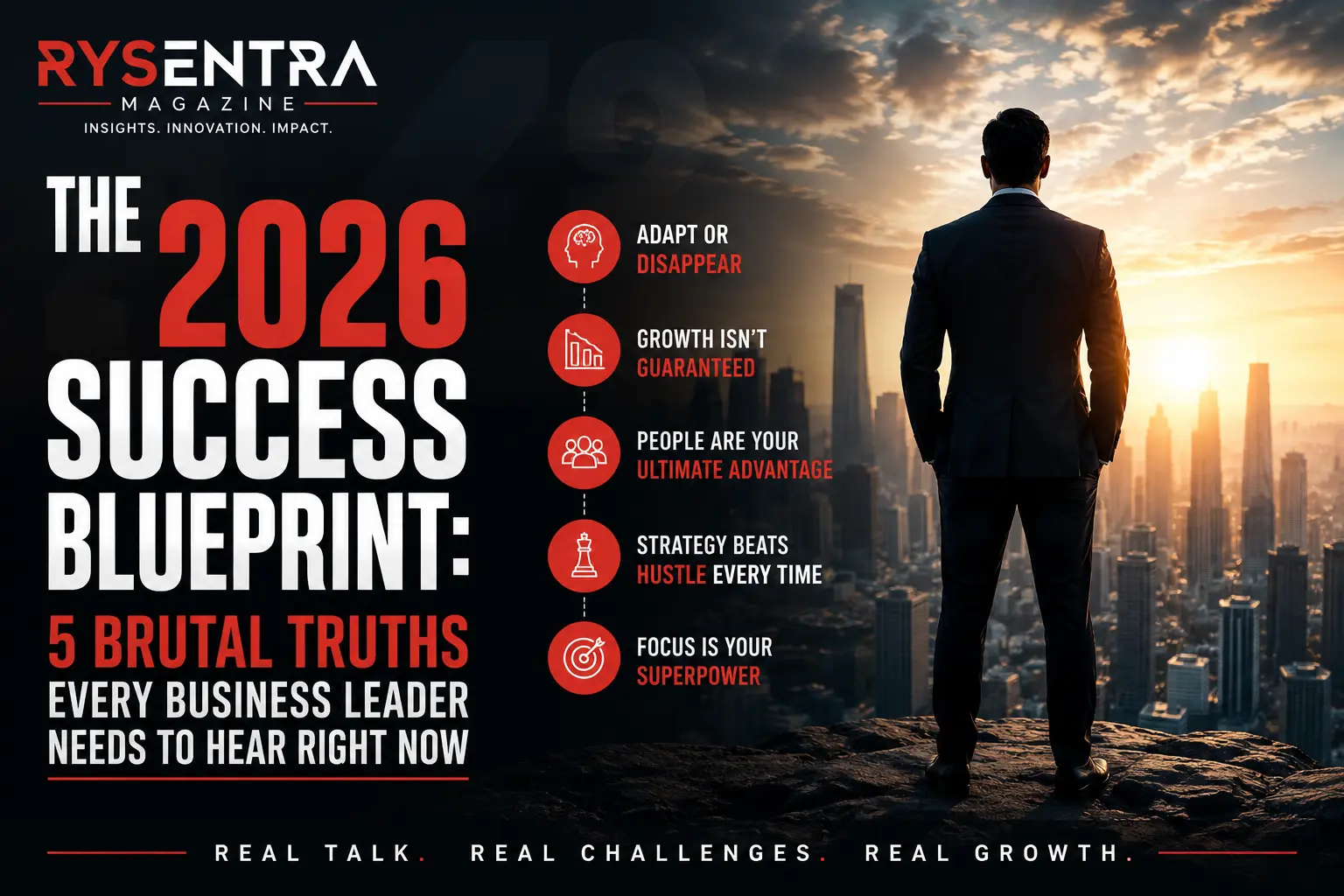
The business world has entered a new era where yesterday’s winning strategies no longer guarantee tomorrow’s success. As organizations navigate rapid technological innovation, shifting customer expectations, and an increasingly competitive global economy, business leaders must rethink how they lead, innovate, and grow.
The year 2026 isn’t simply another milestone—it represents a turning point. Companies that continue relying on outdated leadership models risk falling behind, while those embracing intelligent transformation are positioning themselves for long-term success.
Whether you’re a CEO, entrepreneur, startup founder, executive, or business professional, these five realities could determine whether your organization thrives or struggles in the years ahead.
1. Adaptability Is No Longer Optional
Markets change faster than ever before.

Consumer behavior evolves overnight, new technologies emerge every month, and competitors can disrupt entire industries within weeks.
The most successful organizations in 2026 are not necessarily the biggest—they’re the most adaptable.
Modern leaders embrace continuous learning, encourage experimentation, and create organizations capable of responding quickly to changing market conditions.
What successful leaders do:
- Encourage innovation across every department
- Test new ideas rapidly
- Make data-driven decisions
- Invest in employee upskilling
- Build flexible business processes
Companies that resist change often discover that their competitors have already captured the opportunities they ignored.
Key Takeaway: Adapt quickly—or risk becoming irrelevant.
2. Artificial Intelligence Has Become a Core Business Strategy
Artificial Intelligence is no longer an emerging trend—it’s a competitive advantage.
Forward-thinking organizations are integrating AI into nearly every aspect of their operations, including customer support, marketing, finance, cybersecurity, product development, and decision-making.
Rather than replacing employees, AI empowers teams by automating repetitive work and providing valuable insights that help people make better decisions.
Many growing organizations are now introducing dedicated AI leadership roles or assigning executive responsibility for AI strategy to ensure innovation aligns with business objectives.
Where AI creates value:
- Predictive analytics
- Customer personalization
- Intelligent automation
- Sales forecasting
- Marketing optimization
- Fraud detection
- Product innovation
- Business intelligence
Organizations that fail to adopt AI strategically may find themselves competing against businesses that operate faster, smarter, and more efficiently.
Key Takeaway: AI should be part of your business strategy—not just another software tool.
3. Traditional Hierarchies Are Giving Way to Agile Leadership
The era of slow decision-making is fading.
Modern organizations increasingly rely on empowered teams that can make informed decisions without waiting through multiple layers of approval.
Agile leadership encourages collaboration, accountability, transparency, and faster execution.
Instead of controlling every decision, successful leaders focus on creating environments where talented people can solve problems independently.
Benefits of decentralized leadership:
- Faster innovation
- Better employee engagement
- Improved customer responsiveness
- Increased productivity
- Stronger ownership culture
- Faster execution
When employees feel trusted, they contribute more creative ideas and take greater responsibility for outcomes.
Key Takeaway: Empower people to make decisions where the work happens.
4. Customer Experience Has Become the Ultimate Competitive Advantage
Products can be copied.
Pricing can be matched.
Technology eventually becomes available to everyone.
Customer experience is what truly differentiates successful businesses.
Today’s customers expect personalized interactions, fast support, seamless digital experiences, and genuine relationships with brands.
Businesses that consistently deliver exceptional customer experiences build stronger loyalty, increase referrals, and improve long-term profitability.
Ways to improve customer experience:
- Personalize communications
- Respond quickly across channels
- Use customer feedback to improve services
- Simplify purchasing journeys
- Invest in customer success programs
Organizations that place customers at the center of every decision consistently outperform competitors focused solely on products.
Key Takeaway: Customers remember experiences far longer than marketing campaigns.
5. Continuous Innovation Is the New Growth Strategy
Innovation is no longer reserved for technology companies.
Every industry is being transformed by digital technologies, automation, sustainability, and changing customer expectations.
Organizations that innovate continuously remain resilient even during economic uncertainty.
Innovation doesn’t always require inventing something revolutionary. Often, improving existing processes, enhancing customer experiences, or adopting smarter technologies creates significant competitive advantages.
Build an innovation culture by:
- Rewarding creative thinking
- Encouraging experimentation
- Learning from failures
- Investing in research and development
- Monitoring industry trends
- Collaborating across teams
Businesses that innovate consistently are better positioned to identify new revenue opportunities and respond to market disruption.
Key Takeaway: Innovation is a continuous mindset—not a one-time project.
The Leadership Skills Every CEO Needs in 2026
Modern business leaders must combine traditional management expertise with future-focused capabilities.
Essential leadership skills include:
- Strategic thinking
- Emotional intelligence
- AI literacy
- Data-driven decision making
- Digital transformation leadership
- Effective communication
- Change management
- Innovation leadership
- Financial resilience
- Customer-centric thinking
The leaders who invest in developing these skills today will be better prepared for tomorrow’s business challenges.
Final Thoughts
The business environment of 2026 rewards organizations that embrace change, invest in technology, empower people, and focus relentlessly on delivering value.
Success is no longer determined solely by company size or history. It belongs to leaders willing to evolve faster than the market around them.
The future isn’t waiting—and neither should your business.
The organizations that thrive over the next decade will be those that combine human creativity with intelligent technology, encourage agile leadership, prioritize customer experience, and build cultures where innovation never stops.
The blueprint is clear.
The only remaining question is whether your organization is ready to follow it.
Frequently Asked Questions
What is the biggest business trend in 2026?
Artificial Intelligence, agile leadership, customer experience, and continuous innovation are among the most influential trends shaping business success.
Why is AI important for business leaders?
AI improves efficiency, supports better decision-making, enhances customer experiences, and enables organizations to scale operations more effectively.
How can businesses prepare for the future?
Invest in employee skills, embrace AI strategically, empower teams, focus on customer experience, and build a culture of continuous innovation.
Is your business ready for the Quantum Shift of 2026? As we cross the midpoint of the decade, the gap between “legacy companies” and “future-ready enterprises” is widening into a canyon. Here is the blueprint used by the world’s most successful business leaders to stay relevant.
Decentralized Leadership Structures
The hierarchy is dead. In 2026, Decentralized Autonomous Teams are the standard for success. By empowering teams to make real-time decisions without waiting for “corporate approval,” companies can move at the speed of the market.
The Rise of the “Chief AI Officer”
Every successful startup in 2026 has a Chief AI Officer (CAIO). This role ensures that AI isn’t just a tool, but a foundational part of the company’s DNA. From customer service to product R&D, AI is the engine driving 2026’s success stories.
Summary: Adapt or disappear. The business landscape of 2026 rewards the bold, the decentralized, and the tech-integrated.